
Building Shared Entrepreneurship

Author(s):
Joe Rinehart
Year:
2015
This resource is intended to give small business support organizations a background on how the worker cooperative model can help entrepreneurs reach their dreams.
This resource is intended to give small business support organizations a background on how the worker cooperative model can help entrepreneurs reach their dreams.

Worker cooperatives have increasingly drawn attention from the media, policy makers and academics in recent years. Individual cooperatives across the country have been highlighted, and substantive studies have been conducted of the worker cooperative experience in other countries, including Spain, Italy, France, Canada and Argentina. But what do we know about worker cooperatives in the US as a whole?
After working with professionals to determine which entity type is right for your worker cooperative, the next step is to work with professionals to develop your governing documents. Bylaws and operating agreements should include high-level information about the governance of the organization. They clarify and codify the democratic governance and ownership of your cooperative, help provide a structure through which the cooperative can grow, and provide a last resort for conflict resolution if relationships break down.
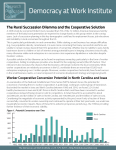
This research paper summarizes an examination of the National Establishment Time Series (NETS) dataset for North Carolina and Iowa to gauge the potential for conversions of existing businesses to worker cooperatives. The data demonstrate that the potential is quite large, and that even if only a fraction of these successfully converted to worker ownership and continued to operate at their last year levels, there would be meaningful economic impacts.

The Democracy at Work Institute/USFWC Press Kit includes information about worker cooperatives, why they are important, examples of existing cooperatives and development organizations, city government initiatives, frequently asked questions, and more.

Becoming Employee-Owned is a guide for business owners interested in employee ownership. It provides an overview of the three primary transition approaches for employee ownership: worker cooperatives, ESOPs, and management buy-outs. Regardless of what stage the business is in--from expansion to succession planning-- this resource can help business owners understand their options for becoming an employee-owned company.

Worker cooperatives are a powerful tool for economic and community development. This resource describes their role in creating a more just economy. It provides an overview of the benefits of the cooperative form, with examples of existing cooperatives and quotes from worker-owners. The resource also describes current initiatives to develop cooperatives by nonprofits, as well as government initiatives to spur the growth of the sector.
When forming, worker cooperatives have an important choice to make regarding their legal entity. Each entity type has implications on important issues including taxation, employment law, and access to capital. This resource is intended to give a brief overview of the entity types and lay out the issues worker cooperatives may want to consider when choosing which is the best fit for the business at whatever stage it is currently in.
At a time when trust in conventional capitalist governance is at a historical low, worker cooperatives demonstrate that, given a fair chance, workers can run the show by themselves and it is indeed a good moment for trade unions to challenge received ideas about worker cooperatives. This journal includes six (6) articles about the relationship between unions and worker cooperatives throughout the world.
Multi-stakeholder cooperatives (MSCs) are co-ops that are owned and controlled by more than one type of membership class such as consumers, producers, workers, volunteers, or community supporters. Stakeholders can be individuals or organizations such as non-profits, businesses, government agencies, or even other cooperatives. Instead of focusing on the needs of a single membership class, MSCs are often built around a broad mission that addresses the interests of the various stakeholder groups. The number of MSCs in the U.S. is small but growing.
